
A flash of green streaks across the skies of Tarangire. It is a Fischer’s lovebird darting between the acacia trees, followed by a flock of companions with brilliantly colored plumage. A few seconds later, your gaze is drawn upward: a martial eagle glides effortlessly on the thermal currents, its wings fully outstretched against the endless blue sky. Then, as the safari vehicle slows along the shores of an alkaline lake, a vast expanse of pink emerges on the horizon. Thousands of flamingos, so densely gathered that they appear like a brushstroke of color painted across the water.
Birdwatching in Tanzania is far from a niche activity or a mere footnote to the safari experience. It is a gateway to a parallel world unfolding above the savannah, among the treetops and along the shores of shimmering lakes, with more than 1,350 resident bird species joined by hundreds of migratory visitors from Europe, Asia, and North Africa. This world-class ornithological heritage transforms every safari day into a continuous journey of discovery.
Birdwatching in Tanzania
Observing birds in Tanzania’s natural landscapes is one of the richest and most underrated experiences a safari can offer. It is not a secondary activity reserved for a niche of specialists, but rather a complementary dimension of exploration that reveals aspects of nature that might otherwise go unnoticed. While traditional game drives focus on large mammals, birdwatching opens a window into remarkably complex aerial ecosystems, where each species plays a distinct role and every behavior tells a story of adaptation shaped over thousands of years.
Tanzania is home to one of the most diverse bird populations on the planet. Its more than 1,350 resident species represent only the permanent core of a community that expands seasonally with the arrival of hundreds of migratory birds from Europe, Asia, and North Africa. Raptors soaring over the vast plains, flamingos transforming entire lakes into shimmering pink landscapes, and weaver birds crafting intricate suspended nests with remarkable precision — every park, every habitat, and every season offers a unique and unforgettable spectacle.
This experience appeals to wildlife photographers and birdwatching enthusiasts alike, yet it possesses a rare quality: the ability to captivate even those who have never picked up a pair of binoculars. Because when faced with a martial eagle diving from the sky or two million flamingos taking flight from Lake Natron, no technical expertise is required to recognize that you are witnessing something extraordinary. All it takes is a willingness to look at the sky with fresh eyes.
A Paradise for birdwatching across national parks and Lake Natron
Tanzania holds a privileged position in the world of birdwatching. It is not simply a matter of numbers, impressive as they may be. What makes the country truly unique is its extraordinary diversity of habitats: vast savannahs, montane rainforests, alkaline lakes, wetlands, high-altitude grasslands, and coastal plains coexist within a relatively compact territory, each supporting its own specialized bird communities.
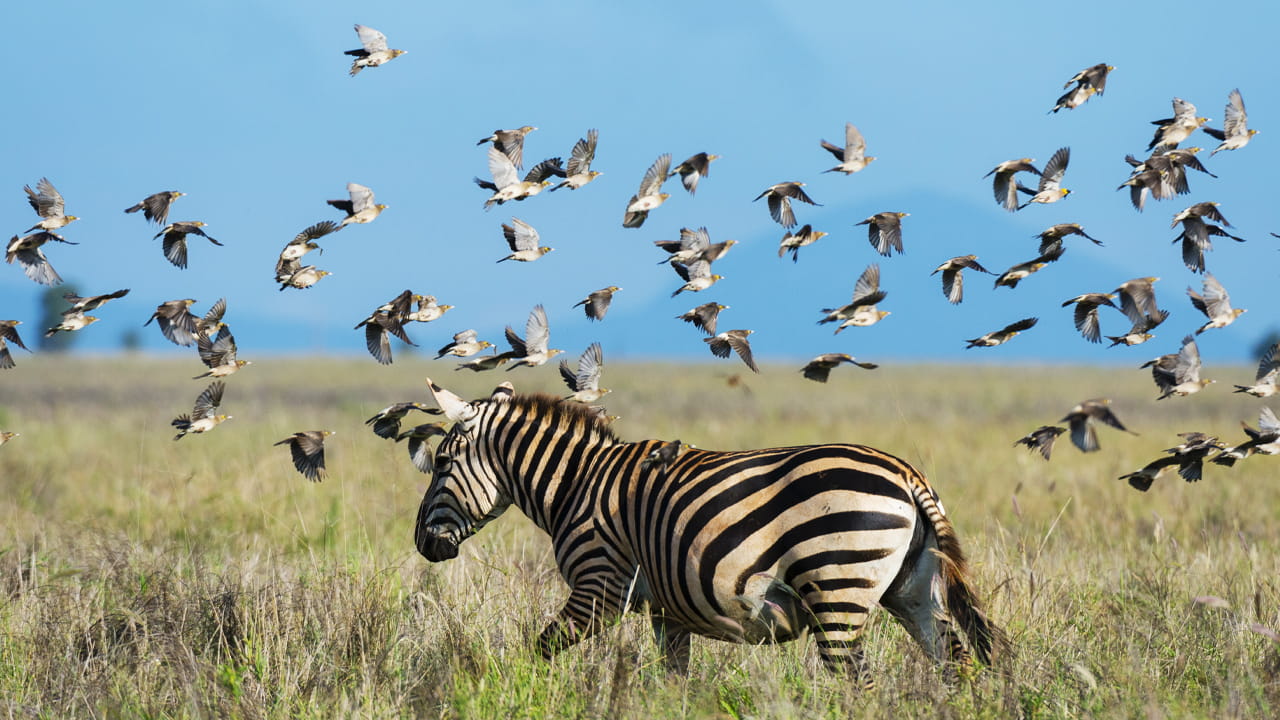
Travelers who choose a safari in Tanzania with the goal of encountering lions, elephants, and leopards soon discover that the African sky is just as populated, just as competitive, and just as spectacular. Majestic raptors patrol the plains with the same authority as their terrestrial counterparts. Flamingos transform entire lakes into vast pink expanses visible from afar. Weaver birds construct suspended architectural masterpieces that would impress even an engineer. It is a world that demands only one new skill: learning to look up.
Birdwatching appeals first and foremost to wildlife photographers and bird enthusiasts, yet it possesses a rare quality: it has the power to captivate even those who have never held a pair of binoculars. Because when faced with a martial eagle diving toward its prey or two million flamingos taking flight at the same moment, the distinction between expert and beginner simply fades away. What remains is pure wonder.
Where to go birdwatching in Tanzania
Tanzania offers a mosaic of natural environments, each with its own unique bird communities. The choice of where to focus birdwatching depends on the overall travel itinerary, the time of year, and the species one hopes to encounter. However, some locations stand out for their density, diversity, and the sheer spectacle of the sightings they offer.
Serengeti
Serengeti National Park is not only the stage for the Great Migration and Africa’s great predators; it is also hunting ground for some of the continent’s most imposing raptors. Its open plains, free of visual obstacles, provide ideal conditions for observing martial eagles, secretary birds, and vultures in soaring flight. The martial eagle, Africa’s largest bird of prey with a wingspan that can exceed two meters, is a regular presence, dominating the skies with silent authority.
But Serengeti is not only about raptors. Ashy starlings dot the branches with their metallic plumage. Scavengers follow moving herds, creating a visible link between terrestrial and avian wildlife. Even the small fork-tailed drongos, with their intelligence and deceptive calls, offer fascinating moments of observation. In this savannah, you only need to look up to discover a second safari unfolding above your head.
Lake Manyara and Tarangire
Lake Manyara and Tarangire National Parks form an ornithological corridor of extraordinary richness. Here, Fischer’s lovebirds — an East African endemic with bright green plumage and a distinctive white eye ring — fly in noisy flocks that look like shards of emerald scattered among the acacia trees. Kori bustards, among the heaviest flying birds in the world, cross the grasslands with a slow, regal stride that contrasts strikingly with their imposing size.
Weavers represent one of the most fascinating spectacles in this region. Their colonies, made up of dozens of intricately woven nests hanging from branches like living lanterns, are masterpieces of natural engineering. Kingfishers with electric-colored plumage patrol the waterways, bee-eaters hunt flying insects in precise aerial acrobatics, and hornbills with oversized beaks move heavily from tree to tree. The diversity of resident species is so rich that every stop becomes an open-air census.
Lake Natron
Lake Natron is one of those places that redefine the very concept of natural spectacle. This alkaline lake, set at the foot of the Ol Doinyo Lengai volcano on the border with Kenya, hosts between 1.5 and 2.5 million lesser flamingos. The figure is worth repeating: up to two and a half million individuals, a concentration that represents roughly three-quarters of the entire global population of the species.
Lake Natron is the most important breeding site in the world for the lesser flamingo. Between August and October, its alkaline mudflats transform into a vast communal nesting ground where thousands of pairs lay their eggs and raise their chicks. The extreme environmental conditions, with waters so highly alkaline they are lethal to most organisms, act as a natural fortress that protects the nesting colonies from predators.
The visual spectacle defies imagination. Waters tinted red and orange by algae and minerals blend with the pink of the flamingos, creating a landscape that feels as though it has been painted by a visionary artist. When thousands of birds take flight simultaneously, a pink wave rising with the sound of beating wings and calls fills the air, offering one of those rare natural events that alone can justify an intercontinental journey.
Arusha National Park and Rubondo Island National Park
Arusha National Park is often overlooked on traditional safari circuits, overshadowed by the larger giants of northern Tanzania. This is a mistake. The Momella Lakes, located within the park, form one of the richest wetland bird habitats in the entire region: flamingos, herons, ibises, cormorants, and various duck species all find an ideal environment here, with the imposing Mount Meru as a dramatic backdrop completing a highly photogenic landscape. Its proximity to the city of Arusha makes it a perfect destination for a day of birdwatching before or after a main safari.
Rubondo Island, on Lake Victoria, represents the least explored frontier of Tanzanian ornithology. Its remote location and diverse habitats, ranging from rainforests to wetlands, attract an exceptional number of resident and migratory bird species. For those seeking a birdwatching experience far from established safari routes, Rubondo is a discovery that more than rewards the effort required to reach it.
How birdwatching is conducted on safari
Birdwatching in Tanzania has a defining characteristic that sets it apart from many other ornithological destinations around the world: it is not a separate activity requiring a dedicated expedition, but an experience that integrates organically into a broader safari. This integration is a strength, not a compromise. It means there is no need to forgo sightings of large mammals in order to focus on birds, as the two dimensions coexist and enhance one another.
Observation takes place throughout the day from a 4×4 safari vehicle, accompanied by a guide specialized in ornithology. The guide’s expertise is what fundamentally transforms the experience: a trained eye can spot camouflaged species invisible to the untrained observer, recognize specific calls, anticipate movements, and position the vehicle in the optimal location for observation and photography. The difference between a general game drive and one led by an ornithologically trained guide is the difference between looking and truly seeing.
The early morning and late afternoon are the most productive moments, when bird activity peaks and the light is ideal for photography. However, even during the central hours of the day—when large mammals rest in the shade and traditional game drives slow down—birds continue to deliver a constant spectacle: raptors soaring on thermal currents, weavers busy building their nests, and kingfishers hunting along waterways. For those on photographic safaris, birdwatching is a creative opportunity that never pauses and fills every moment of the day with possibility.
When is the best time for birdwatching in Tanzania?
Tanzania offers birdwatching opportunities throughout the year, but the choice of season significantly influences which species can be observed and in what numbers. Understanding the seasonality of sightings is essential for planning a trip that maximizes the ornithological experience.
The dry season, from June to October, is the ideal period for observing resident bird species. The sparser vegetation greatly facilitates sightings, birds concentrate around remaining water sources creating spectacular gatherings, and clear skies provide perfect conditions for spotting raptors in flight. It is also the period when many species are engaged in breeding, offering remarkable scenes of courtship and nest building.
From November to March–April, Tanzania becomes a crossroads of intercontinental migration routes. Birds arriving from Europe and Asia — swallows, storks, European bee-eaters, falcons, and dozens of other species — undertake their seasonal journey south, joining the resident populations. During these months, observable diversity reaches its absolute peak, making this the most exciting and rewarding period for enthusiasts, full of unexpected sightings.
For those wishing to witness the flamingo spectacle at Lake Natron, the best period is between August and October, when nesting is in full swing and the concentration of birds reaches numbers that defy comprehension. It is a relatively short time window, but its visual intensity has no equal in the world of ornithology.
The rainy season, while presenting some logistical challenges, transforms the landscape into a lush explosion of green and coincides with the peak breeding activity of many resident species. There is no wrong time for birdwatching in Tanzania. The spectacle changes, but not its quality.
Practical Information and requirements
Organizing a birdwatching experience in Tanzania is easier than one might imagine. Since it is an activity integrated into a safari, logistics are already included in the overall trip arrangement. However, a few practical details can make the difference between a good experience and a perfect one.
Who can participate
Safari birdwatching is an exceptionally accessible activity. The entire experience takes place comfortably seated in a 4×4 vehicle, with no need to walk, climb, or perform any physical effort. This makes it ideal for travelers of all ages and fitness levels: families with children, senior travelers, and anyone who prefers a contemplative experience that does not require athletic exertion.
Designed for wildlife photographers and birding enthusiasts, the experience nevertheless has a rare quality: it can captivate even those encountering birdwatching for the first time. The specialized guide turns every sighting into a moment of discovery, making observation accessible and engaging regardless of prior knowledge. You don’t need to be an ornithologist to be left breathless in front of a diving martial eagle.
What to bring
Binoculars are the essential tool for any birdwatcher and are included in the package. Those who own a high-quality pair are encouraged to bring them, especially if they offer higher magnification or particularly bright optics, which are especially useful during the early morning hours.
For photography, a camera with a telephoto lens is strongly recommended. Many species are observed at distances that require long focal lengths, and the quality of images that can be captured during a birding safari fully justifies suitable optics. Even the latest-generation smartphones, when paired with a binocular adapter, can deliver surprising results for those who do not have professional equipment.
The ideal clothing is layered and in neutral colors: earthy and green tones help avoid disturbing more sensitive species. A wide-brimmed hat provides protection from the sun during the central hours of the day, and a light jacket is recommended for early morning outings, when temperatures on the savannah can be surprisingly cool.
What’s included
The birdwatching package is comprehensive and designed for a worry-free experience. It includes a specialized ornithology guide, a 4×4 vehicle for the entire day, park entrance fees, binoculars, and meals. The itinerary can be customized on request, allowing guests to focus on the areas and species of greatest interest.
This flexibility represents a significant added value. Those who wish to spend more time at Lake Natron for flamingos, those who prefer to focus on the raptors of the Serengeti, and those who want to explore the Momella Lakes in search of waterbirds: every priority can be accommodated in an itinerary tailored to the traveler’s personal interests and passions.
Why choose birdwatching with Tracks of Africa
Birdwatching in Tanzania requires far more than a pair of binoculars and good intentions. It demands deep knowledge of the terrain, the ability to interpret environmental signals, and experience in positioning the vehicle for optimal sightings without disturbing sensitive species. Above all, it requires guides who have devoted years to the study of African ornithology and who can transform a game drive into an experience that is both scientific and emotionally compelling.
Tracks of Africa, a safari tour operator in Tanzania with a well-established reputation in the tourism sector, provides ornithology-specialized guides with encyclopedic knowledge of the species found across different parks. They know where raptors nest, at what times flamingos take flight, and along which waterways kingfishers are most commonly found. This level of expertise cannot be improvised: it is the result of years of field experience that transform an ordinary game drive into a world-class birding experience.
The integration of birdwatching into any safari itinerary is seamless and natural. Whether it is a short trip focused on one or two parks or an extended adventure covering the best of Tanzania, birdwatching acts as a guiding thread that enriches every day, every transfer, and every stop. It is not an activity that is simply added on: it is a different lens through which to experience the safari.
Looking at Tanzania’s skies with fresh eyes does not mean turning away from the savannah. It means discovering that above it moves an equally complex, equally fierce, and equally breathtaking universe. And when a martial eagle plunges toward its prey just a few meters from the vehicle, or two million flamingos turn a lake into a living, breathing expanse of pink, it becomes clear that the safari you thought you knew still had an entire dimension waiting to be explored.
Ready to discover the skies of Tanzania? Contact us to integrate birdwatching into your tailor-made safari.