
Sound comes before anything else. A rhythmic, metallic thud, mingling with the crackling of the fire and the whoosh of the bellows. Then the smell: burning charcoal, warm earth, iron bending under the blows of the hammer. This is how the encounter with the Datoga tribe in Tanzania begins – through the senses, even before words. In the Lake Eyasi region of northern Tanzania, this ancient people of blacksmiths and herders continue to live according to rhythms that the modern world has forgotten.
Visiting the Datoga people is not a tourist excursion in the conventional sense of the term. It is a step into a different dimension, where time is measured in seasons and generations, where every object is handcrafted and every daily gesture carries the weight of a millennia-old tradition. For those arriving from the hustle and bustle of Western cities, the impact is as quiet as it is profound: there is no spectacle, no staged effects designed for the visitor. There is only the real life of a people who have chosen, with stubborn determination, to remain true to themselves.
Datoga tribe in Tanzania: a visit to the village on Lake Eyasi
The Datoga are one of Tanzania’s most fascinating and least well-known ethnic communities. In a country where the Maasai attract much of the media and tourist attention, this people of Nilotic origin possess a cultural heritage of extraordinary richness that deserves to be explored with the same curiosity as that reserved for the great national parks and wildlife.
Known as the blacksmiths of the savannah, the Datoga have transformed metalworking into an art form that defines their identity and sets them apart from every other community in the region. Their traditional forges produce tools, weapons and jewellery that are not merely artefacts but tangible expressions of a culture that has been passed down from father to son for centuries. It is an ancient craft that withstands the pressures of modernisation, a trade that tells the story of a proud and resilient people better than any book ever could.
The experience of visiting a Datoga village forms part of that strand of cultural tourism which enriches the traditional safari with a human and anthropological dimension. After days spent tracking the Big Five and admiring sunsets over the savannah, an encounter with the Datoga offers a valuable contrast: the chance to see Africa not only through its extraordinary wildlife, but also through the faces, hands and stories of the people who have inhabited this land for millennia.
Discovering Tanzania’s blacksmiths
There is a reason why the Maasai, Africa’s most famous warriors, refer to the Datoga by a term that translates as ‘respected enemy’. This people of herders and craftsmen have never bowed to the cultural dominance of their more famous neighbours, preserving their identity with a tenacity that has few equals in the ethnic landscape of East Africa.
The Datoga are a people of Nilotic origin who speak their own language, Datoga, which is related to that of the Maasai but distinct in structure and vocabulary. Their resistance to modernisation is as radical as it is deliberate: only a tiny proportion of the population speaks Swahili, Tanzania’s national language, and formal schooling remains the exception rather than the rule. For those organising a safari in Tanzania that goes beyond simply observing wildlife, an encounter with the Datoga offers an authentic immersion in a world that seems to exist outside the flow of time, where social, economic and spiritual dynamics follow ancient and deeply rooted customs.
Mastery of metalworking is not merely an economic activity: it is the cultural trait that defines the very identity of the Datoga people, the thread that links past and present, and the generations that follow one another around the same forge.
Who are the Datoga?
To fully appreciate the significance of a visit to a Datoga village, it is helpful to understand the origins of this people and the characteristics that make them unique within Tanzania’s ethnic mosaic. Their history is a tale of migration, adaptation and resilience that spans millennia and continents, eventually taking root in the lands that today surround Lake Eyasi, one of the most evocative and least touristy places in northern Tanzania.
Origins and history
The Datoga are a people of Nilotic origin who are believed to have migrated to Tanzania around 3,000 years ago from the regions of southern Sudan and the highlands of western Ethiopia. This centuries-long migration led them to gradually settle in the Lake Eyasi basin, the Mbulu highlands and the Manyara and Singida regions, where the majority of the community – estimated at around 100,000 people – still lives today.
Their language, Datoga, belongs to the Southern Nilotic branch and features several dialectal variants amongst the various clans, of which the Barabaig are the largest and best-known subgroup. Oral tradition is the main vehicle for collective memory: songs, proverbs, riddles and ancestral myths pass on the history of the people to new generations, keeping alive a cultural heritage that, whilst lacking a written form, possesses extraordinary depth.
Traditions and daily life
The Datoga are traditionally herders and breeders of cattle, goats and sheep. Livestock is not merely an economic resource: it is the centrepiece of social life, the measure of wealth, the currency of marriage exchanges and the central element of every ritual. The meat, milk, blood, fat, hides and even the manure of every animal are put to practical or ceremonial use, in a subsistence system that wastes nothing.
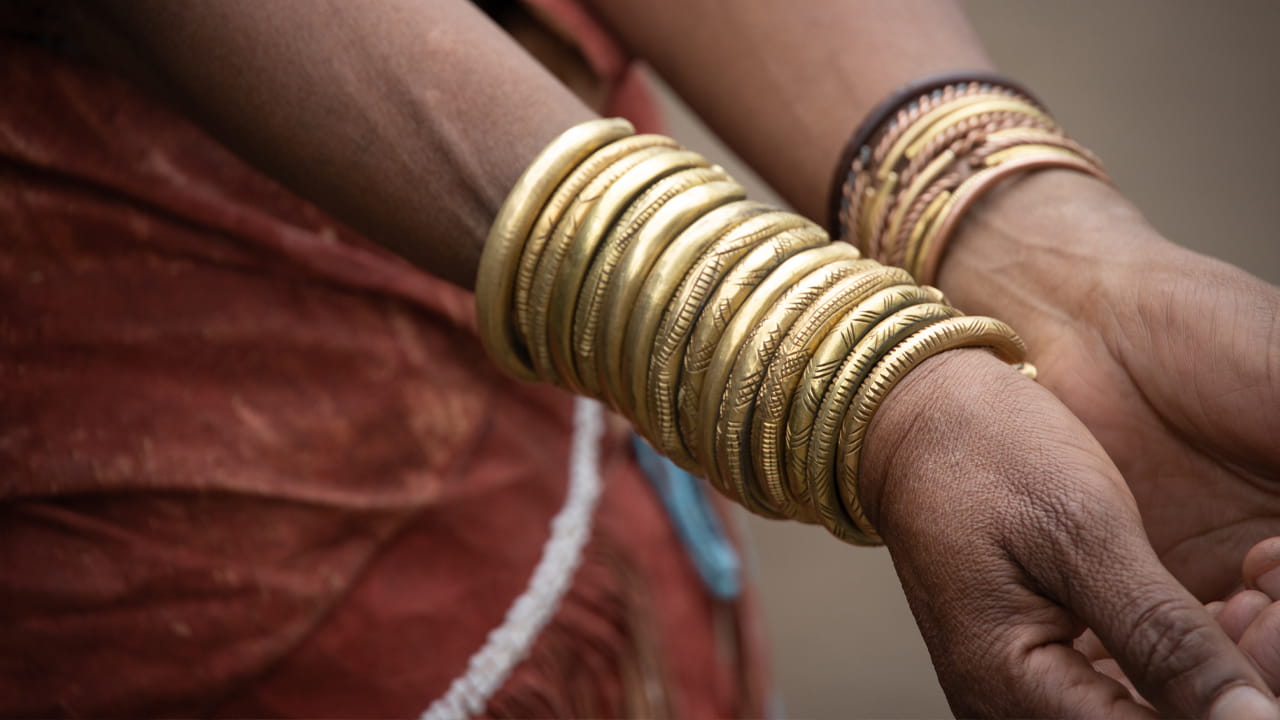
The social structure is patrilineal and polygamous. The wealthiest men may marry several wives from different clans, maintaining separate households in order to gain access to a greater variety of grazing and farming land. Datoga women are instantly recognisable by the decorative tattoos that adorn their faces and shoulders – circular patterns around the eyes that represent a distinctive aesthetic feature steeped in cultural significance. Jewellery made of copper, iron and beads completes an image that is striking for its expressive power: each piece is handcrafted by the community’s blacksmiths, as part of a cycle of self-production that makes the Datoga extraordinarily self-sufficient.
What happens during a visit to the Datoga tribe?
A visit to a Datoga village lasts around two hours and offers an immersive insight into the daily life, traditional crafts and social fabric of this community. Unlike wildlife safaris, there are no animals to track down here, nor are there timetables dictated by nature: the pace is that of the community itself – slow and authentic – marked by the daily routines of people living according to customs handed down through generations.
Arrival at the village and welcome
Arrival at the village marks the first moment of direct contact with the Datoga world. The guide and the cultural mediator – both essential to the success of the experience – introduce visitors to the community and provide an initial overview of the people’s traditions, history and social structure. This introduction is not a didactic monologue but a bridge between two worlds: it prepares visitors to understand what they are about to witness and lays the groundwork for respectful and meaningful interaction. The traditional dwellings – circular huts built from branches, grass and mud – offer the first visual glimpse of a way of life that makes no concessions to modernity.
Demonstration of craftsmanship and metalworking
The highlight of the visit is undoubtedly the demonstration at the forge, the moment when the Datoga’s cultural identity is expressed in its most powerful and tangible form. The village blacksmiths work using basic tools – hand-operated bellows and hammers – to melt and shape recycled iron, often salvaged from scrap car parts or disused agricultural equipment. From this raw material, they craft arrowheads, spears, knives, bracelets and ornaments of remarkable craftsmanship.
Arrowheads, in particular, form the centrepiece of an ancient barter system with the neighbouring Hadzabe tribe, a hunter-gatherer people who rely on Datoga artefacts for their hunting activities and who, in return, offer wild honey, meat and animal skins. Visiting the Hadzabe tribe as part of the same itinerary allows you to appreciate this symbiotic relationship between two profoundly different peoples who are bound by a bond of mutual respect.
Another engaging experience is taking part in the traditional grinding of maize on a stone, a task that the women carry out every day and which visitors can try for themselves, discovering the effort and precision required by what appears to be a simple task.
Engagement with the community
The final part of the visit allows for free interaction with members of the community. You can observe domestic life, livestock farming, the craftwork of the women who make beaded ornaments, and simply share moments of everyday life with people whose existence unfolds along completely different lines from our own. It is not uncommon for spontaneous exchanges to take place – smiles, gestures and attempts at communication that transcend the language barrier – and these often become the most vivid memories of the entire experience. The children, curious and lively, are often the first to seek contact, transforming the visit into a moment of genuine shared humanity.
Where is the Datoga tribe located?
The Datoga people live mainly in the Manyara and Singida regions, with the largest concentration of communities in the Lake Eyasi basin area in northern Tanzania. The area is easily accessible during a safari on the Northern Circuit, although it lies slightly off the beaten track compared to the routes linking the Serengeti, Ngorongoro and Tarangire.
It is precisely this less conventional setting that contributes to the authenticity of the experience. Lake Eyasi and the communities surrounding it have not yet been transformed by mass tourism, and a visit to the Datoga retains a sense of authenticity that can be harder to find elsewhere. This experience is recommended as part of a wider itinerary, ideally an 8-day safari in Tanzania or longer programmes, allowing you to devote half a day to cultural exploration without sacrificing time in the parks. Combining it with a visit to the Hadzabe, who live in the same area, creates a day devoted entirely to discovering Tanzania’s indigenous cultures – a perfect counterpoint to the days spent on game drives.
Practical information and requirements
Organising a visit to the Datoga tribe doesn’t require any special preparations, but knowing a few practical details helps you to approach the experience with the right mindset. Here’s what you need to know before heading to one of the most culturally rich corners of Tanzania’s national parks.
Who can take part
A visit to the Datoga is an experience open to everyone, with no age limits or restrictions on group sizes. Families with children are welcome, and young children often find the experience particularly engaging, fascinated by the blacksmith’s forge, the animals and the chance to interact with their peers in the village. No particular physical fitness is required: the entire experience takes place within the village, on flat ground and without any strenuous walking.
What to bring
Normal clothing is recommended; no special equipment is required. The only important thing to bear in mind is to bring cash for any purchases of local handicrafts: the Datoga produce copper and iron bracelets, beaded necklaces, small tools and ornaments, which serve not only as an authentic souvenir of your trip but also as a direct contribution to the community’s economy. Photography and filming are permitted, and there are plenty of opportunities to take pictures, from the forge in action to portraits of community members.
What’s included
The tour package includes an expert guide, an interpreter and a contribution to the community, which ensures direct support for the village. The experience lasts approximately two hours and can be scheduled in the morning or afternoon, depending on the organisation of the overall itinerary. Advance booking is required, as availability is also subject to the community’s own decisions.
It is important to note that the cost of the visit is treated as an additional activity on top of the main safari package. This is standard practice for cultural experiences in northern Tanzania, and the supplement reflects both the value of the experience and the direct financial contribution to the Datoga community – a key factor in ensuring that tourism generates tangible benefits for local people.
Why visit the Datoga with Tracks of Africa
Visiting an indigenous community requires sensitivity, expertise and an approach that puts respect for the people first. It is not something that can be improvised or managed by operators who lack established relationships with local communities. Tracks of Africa, a safari tour operator in Tanzania with years of experience in the Northern Circuit, has, over time, built a direct relationship with the Datoga communities, based on mutual trust and the assurance that every visit takes place with full respect for the tribe’s traditions and wishes.
The guides and cultural mediators selected by Tracks of Africa are not merely tour leaders: they are professionals who are familiar with the language, history and social dynamics of the Datoga, and who are able to transform a visit into an experience of genuine understanding rather than a mere tourist spectacle. This expertise makes all the difference between a superficial excursion and an encounter that leaves a lasting impression on the traveller’s memory.
A visit to the Datoga can be seamlessly incorporated into any bespoke itinerary, combining it with a visit to the Hadzabe and game drives in the parks of northern Tanzania. It is an element that enriches the safari with a unique human dimension, because after marvelling at lions, elephants and sunsets over the savannah, returning home with the memory of the sound of a hammer on an anvil and the proud gaze of a Datoga blacksmith means taking home a piece of Africa that goes beyond the postcard.
Ready to meet the blacksmiths of the savannah? Contact us to include a visit to the Datoga in your bespoke safari in Tanzania.