
The sun sets behind the African horizon. The savannah turns a deep blue, then black. The stars begin to dot the sky in a density that city dwellers have forgotten even exists. And whilst the tourists return to their lodges for dinner, you climb into a 4×4 vehicle equipped with powerful spotlights. The African night is not the end of the safari: it is the beginning of a completely different adventure. The night game drive in Tanzania takes you where few venture, into that secret world that awakens when darkness falls.
A night game drive isn’t just a safari in Tanzania with less light: it’s an experience that redefines the very concept of wildlife viewing.
Night Game Drive in Tanzania: What Is a Night Safari?
Exploring the savannah at night is one of the most intense and immersive experiences a safari has to offer. Whilst traditional daytime game drives allow you to observe animals during the hours when most species are active, a night safari opens the door to a parallel universe, populated by creatures that live in the shadows and rarely venture into the sunlight.
The night game drive takes place in specially equipped 4×4 vehicles fitted with high-powered spotlights, capable of illuminating the savannah without disturbing the animals. Guides specialising in nocturnal wildlife know exactly where to direct the beam of light, which sounds to interpret in the darkness, and how to distinguish the movement of a branch swaying in the wind from that of a predator lying in wait. This is not an activity available in all of Tanzania’s parks; only certain protected areas, such as Tarangire and Lake Manyara, have obtained the necessary permits to allow this form of exploration after sunset. And it is precisely this exclusivity that makes it all the more special.
The thrill of exploring the savannah after sunset
There is something primal about crossing the savannah in the dark. The senses are heightened, and one’s attention becomes absolute. Every sound takes on a different meaning; every shadow might conceal an extraordinary encounter. The silence of the African night is never truly silence: it is a tapestry of sound woven from calls, rustles and distant cries that tell tales of hunting and survival.
When the beam of the spotlight catches the glint of two eyes in the night, time seems to stand still. It could be a leopard that has just come down from a tree to begin its night-time hunt. Or a genet, a small spotted carnivore that is rarely seen during the day. Or perhaps a porcupine with its quills raised, searching for roots and tubers in the darkness. The adrenaline rush felt in these moments is hard to describe: it is a mixture of excitement, respect and wonder at a world that normally remains invisible to human eyes.
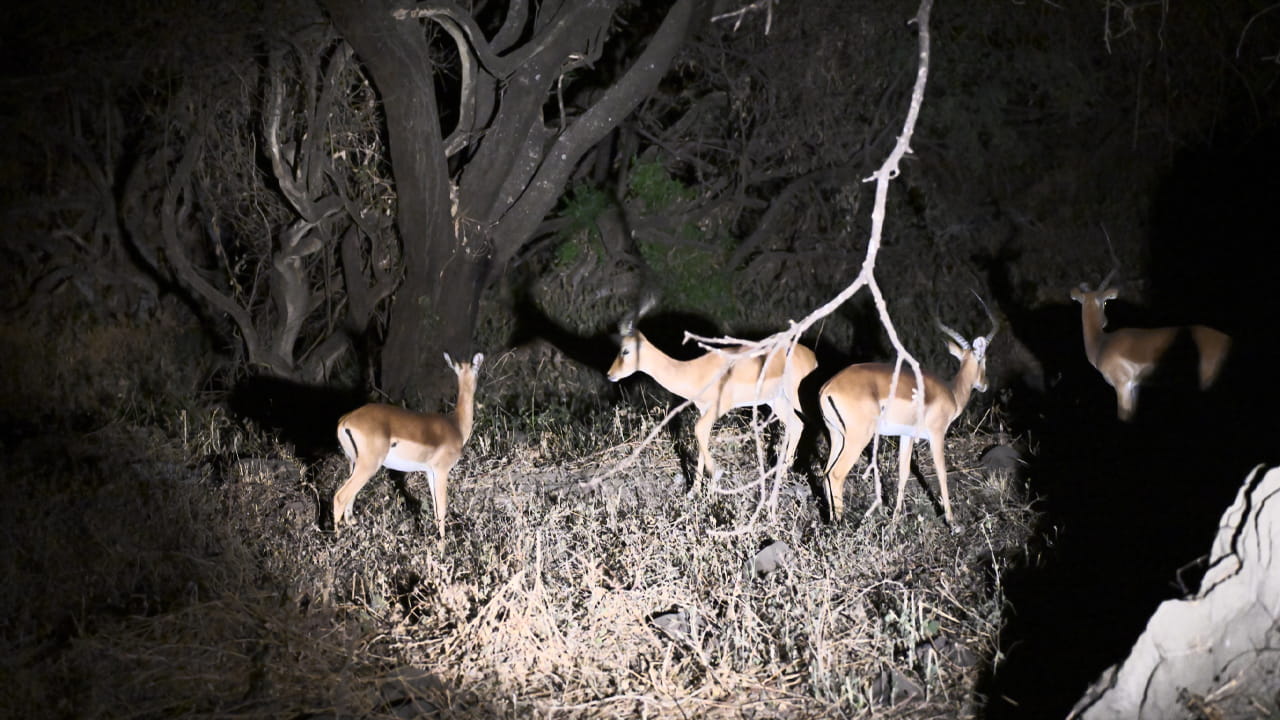
The golden light of sunset gives way to a completely different palette. The headlights illuminate sections of the landscape, creating dramatic contrasts: the silhouettes of acacia trees standing out against the starry sky, the glowing eyes of the animals, the gigantic baobabs taking on almost ghostly forms. It is a natural theatre where every scene is unique and unrepeatable, where nature reveals its most authentic and wild side.
Where does the night game drive take place?
Not all of Tanzania’s national parks allow night safaris. Park authorities impose strict restrictions to ensure visitor safety and respect for the ecosystems. Only in specific areas, where conditions permit and where the necessary infrastructure exists, is it possible to enjoy this extraordinary experience. Currently, two parks in the Northern Tanzania circuit offer regular night game drives: Tarangire and Lake Manyara, each with unique features that make the night-time experience memorable.
Tarangire
At night, Tarangire National Park is transformed into a magical setting. The monumental baobab trees, already impressive in daylight, take on an almost mythical quality in the darkness when illuminated by spotlights. The park is home to a significant population of leopards, the quintessential nocturnal predators, which are most likely to be spotted here during evening game drives.
But it is not just the big cats that make the night game drive in Tarangire so special. Genets, small carnivores with spotted fur, become active after sunset, nimbly climbing trees in search of prey. Porcupines, with their distinctive quills, emerge from their burrows to feed. Galagos, nocturnal primates with enormous eyes and a prodigious leap, move through the branches with astonishing speed. Even the elephants, present in large numbers in the park, display different behaviour at night, appearing more relaxed and less wary.
Lake Manyara
Lake Manyara National Park offers a completely different experience at night. The variety of habitats found in the park – from acacia forest to the shores of the alkaline lake, and from grasslands to marshy areas – creates ideal conditions for an extraordinary diversity of nocturnal wildlife.
Here, the chance of spotting wildlife ranges from predators to crepuscular herbivores, from nocturnal birds to small mammals that only emerge from their burrows once the sun has set. The scenery is among the most captivating in northern Tanzania: the lake reflecting the moon, the mountains of the Rift Valley silhouetted against the backdrop, and the dense vegetation that makes every sighting all the more thrilling because it has been earned. At night, Manyara reveals a side of its character that remains completely hidden from daytime visitors.
How does the night safari work?
The night game drive is a carefully planned experience lasting around two hours, from the evening departure until the return to the camp or meeting point. Every stage is organised to maximise the chances of sightings whilst respecting park regulations and the animals’ welfare. Unlike a balloon safari, which requires an early morning wake-up call, the night safari allows you to enjoy the sunset and dinner before setting off on your adventure, making it perfect for those who prefer not to get up too early.
Evening departure and transfer
Pick-up usually takes place between 7.30 pm and 8.00 pm, when it is now completely dark and the savannah has taken on its nocturnal appearance. Departures do not always take place directly from the lodge: many camps and accommodation facilities are located outside the park boundaries, and in such cases there is a designated area from which all night-time activities depart, reached via a short transfer.
The 4×4 vehicle is already fitted with powerful spotlights mounted on the roof. The guide, who specialises in nocturnal wildlife, gives a quick briefing: he explains what to expect, how to behave, and what techniques will be used to spot the animals in the dark. The atmosphere is charged with anticipation. The stars above the savannah shine with an intensity rarely seen elsewhere, and as the vehicle moves through the darkness, the sounds of the African night begin to grow clearer.
The game drive with spotlights
Then the real exploration begins. For about two hours, the vehicle travels slowly along the park’s tracks whilst the spotlights scan the darkness. The guide knows exactly where to direct the beam of light: onto the lower branches of trees where leopards might be resting, into the clearings where genets hunt, and along the paths frequented by porcupines.
The spotlights used are designed to illuminate without causing disturbance. The light is powerful yet focused, capable of reaching considerable distances without dazzling the animals or significantly altering their behaviour. When an animal is spotted, the guide adjusts the intensity of the light, allowing for observation without interference.
For those who go on photo safaris, night game drives present unique technical challenges. Night photography requires high ISO settings, short exposure times despite the lack of light, and precise focusing in difficult conditions. But the images you can capture—a leopard illuminated by the headlights with eyes shining in the night, a genet moving through the branches, a porcupine with its quills lit up—are simply impossible to obtain during daytime game drives.
Return to the lodge or camp
After around two hours of exploring, the vehicle returns to the starting point. The final journey back to the lodge or camp takes place in the dark, and sightings often continue along the way: the eyes of animals moving at the roadside, the sounds of the savannah accompanying the return journey.
It’s the perfect time to share the emotions you’ve experienced, to look back at the photos you’ve taken, and to etch the most incredible scenes into your memory. You can feel the tiredness setting in, but it’s a pleasant kind of tiredness – the sort that follows an intense and fulfilling experience. And as you get ready for bed, the realisation that you’ve witnessed something few others ever see makes your rest all the sweeter.
Which animals can be spotted at night?
Tanzania’s nocturnal wildlife is extraordinarily rich and diverse. Many species display completely different behaviour during the hours of darkness, whilst others are exclusively nocturnal and impossible to spot during daytime game drives. Sightings are never guaranteed; nature remains unpredictable, and this unpredictability is part of the charm of the experience, but the chances of encountering nocturnal animals during a well-organised evening safari are very high.
Leopards are perhaps the most sought-after sight on any night game drive. These magnificent big cats are predominantly nocturnal, and the chances of spotting them increase dramatically after sunset when they begin their hunt. In Tarangire in particular, where the leopard population is substantial, it is not uncommon to spot one perched on a low branch or moving silently through the trees when illuminated by spotlights.
Genets are small carnivores with spotted fur, distant relatives of mongooses, which lead an almost entirely nocturnal existence. Agile climbers, they hunt both on the ground and in trees, feeding on small mammals, birds and insects. During the day they remain hidden in tree hollows or among the rocks, but after sunset they become active and are relatively easy to spot.
Porcupines are among the most distinctive animals of the night-time savannah. With their long, sharp quills, these large rodents emerge from their burrows after dark to feed on roots, bulbs and bark. The sound they make as they move through the undergrowth helps experienced guides to spot them, and when they are illuminated by the headlights, the sight of their quills standing on end is truly impressive.
Galagos, also known as ‘bush babies’ because their call resembles a baby’s cry, are small nocturnal primates with enormous eyes perfectly adapted to night vision. Their remarkable leaps through the branches – they can cover distances of up to two metres in a single bound – are a display of agility and precision. Seeing them move swiftly through the foliage, illuminated for just a few seconds by spotlights, remains an unforgettable memory.
But the night-time safari isn’t just about mammals. Owls of various species, from the large African eagle owl to the tiny scops owl, become active after sunset. Their distinctive calls break the silence of the night, and when the headlights catch the glint of their eyes amongst the branches, the effect is almost hypnotic. Other nocturnal birds, such as the nightjar, can be spotted hunting insects in flight.
And then there are the big predators. As well as leopards, you may come across lions setting out on their night-time hunt, hyenas moving in packs, and jackals taking advantage of the darkness to search for food. Witnessing scenes of night-time hunting – a predator silently closing in on its prey, the moment of the attack, the desperate flight – is a rare privilege that only a night game drive can offer.
When to book the night safari
Night game drives are available all year round, offering considerable flexibility when planning your trip. However, there are important considerations relating to both individual park restrictions and seasonal conditions that may affect the quality of the experience.
National park authorities impose specific rules for night safaris. Not all vehicles are permitted, not all guides are authorised to lead them, and return times must be strictly adhered to. These restrictions vary over time and may change depending on administrative decisions or conservation requirements. For this reason, it is essential to rely on experienced operators who are fully familiar with the current regulations and can ensure that the activity is conducted in full compliance with the rules.
In terms of the seasons, night safaris are enjoyable at any time of year, though there are some significant differences. During the dry season, from June to October, night-time temperatures can drop considerably, especially in parks situated at higher altitudes. In these circumstances, warm clothing is essential: a thick jumper or a light down jacket makes all the difference between a comfortable experience and two hours of intense cold in an open-top vehicle.
Anyone wondering when to go to Tanzania for a safari should know that a night game drive can be easily incorporated into any itinerary, regardless of the month chosen. The rainy season, when many animals give birth, can offer particularly interesting sightings of young animals beginning to explore the night-time world. The dry season, with its concentration of wildlife around water sources, makes sightings easier but requires greater attention to clothing.
Practical information and requirements
Organising a night game drive doesn’t require any complicated preparations, but knowing a few practical details will help you get the most out of the experience. From suitable clothing and photography equipment to what’s included in the package, having all the information clear in your mind means you can focus solely on the pleasure of exploring at night, without any logistical worries.
Who can take part
A night safari is an exceptionally inclusive activity, suitable for virtually all travellers. There are no strict age restrictions: even children can take part, making it the perfect experience for families who want to share the thrill of exploring the savannah after sunset. For younger children, in fact, the night game drive often holds a special, almost magical charm, turning the safari into an even more memorable adventure.
No particular physical fitness is required. The entire activity takes place whilst comfortably seated in the 4×4 vehicle, with no need to walk or exert yourself physically. This makes it accessible even to people with reduced mobility or those who simply prefer experiences that do not require physical exertion.
This experience is perfectly suited to a wide range of travellers: couples seeking a romantic adventure beneath the African stars, nature photographers keen to capture unique images, wildlife experts looking to add to their list of observed species, and groups of friends in search of thrills. What they all have in common is a curiosity about the hidden side of the savannah – that nocturnal world that usually remains unseen by tourists.
What to bring
The right clothing can make a huge difference to your comfort on a night safari. Although Tanzania is a tropical country, temperatures can drop significantly after sunset, particularly during the dry season and in parks situated at higher altitudes. A thick jumper is an absolute essential; during the coldest months of the year (June–August), a light down jacket or a thermal jacket is strongly recommended.
The vehicle is open-top to allow for maximum visibility, which means you’re exposed to the wind whilst driving. Dressing in layers is always the best approach: it allows you to adjust your comfort level according to the actual temperature and the vehicle’s speed.
As for equipment, a camera and binoculars are essential. Night photography presents specific technical challenges – you need cameras that perform well at high ISO settings, fast lenses, and ideally image stabilisation – but the results can be spectacular. Binoculars help you keep track of the animals when they move beyond the range of the spotlights.
A frequently asked question concerns personal torches. The answer is simple: they are not necessary. Lighting is provided entirely by the powerful spotlights fitted to the vehicle, and using personal torches could actually disturb the animals or interfere with the guide’s work. It is best to rely entirely on the vehicle’s professional equipment.
What’s included
The night game drive package is generally comprehensive and well-organised. It includes a specially equipped 4×4 vehicle fitted with spotlights – essential for night-time lighting – and a guide specialising in nocturnal wildlife, a crucial factor in the success of the experience. Not all guides are qualified to lead night safaris: specific training, in-depth knowledge of animal behaviour after dark, and authorisation from the park authorities are required.
This also includes special permits for night game drives, which are separate and additional to standard park entry tickets. These permits are subject to a fee and are subject to limited availability, which is why advance booking is always recommended.
It is important to note that park fees and the specific costs of the night safari are generally treated as extras on top of the main safari package. This is standard practice in most itineraries, and the additional cost reflects the exclusivity and logistical complexity of the activity. Reputable operators always provide a clear and transparent quote that specifies what is included in the basic package and what supplements are required.
Private or shared experience
The standard configuration allows for a maximum of six participants per vehicle, ensuring that everyone has sufficient space, good visibility and comfort during the two-hour exploration. Six people strike the right balance between a shared experience that maintains a lively atmosphere and collective enthusiasm, and adequate personal space to enjoy the sightings without feeling cramped.
Sharing a night game drive with fellow travellers has its advantages. The heightened excitement, the knowing glances when an extraordinary sighting materialises, and the exchange of impressions and interpretations create a sense of camaraderie that enriches the experience. Friendships often blossom during these nocturnal adventures, forged by the shared memory of a leopard illuminated in the night or a porcupine crossing the road in front of the vehicle.
However, it is always possible to book a private game drive, reserved exclusively for your group. This option is particularly popular with couples seeking a moment of complete privacy under the African stars, or with families who wish to enjoy the experience without the presence of strangers. Professional photographers often prefer private game drives as they allow for greater flexibility in terms of stops and observation times.
The choice between a shared or private tour depends on personal preferences, budget and the aims of the experience. Both options offer the same quality of exploration, the same well-equipped vehicles and the same expert guides. The only difference is the social setting in which you experience the night-time adventure.
Why choose the night game drive with Tracks of Africa
Exploring the savannah at night requires specific skills, appropriate equipment and strict adherence to regulations. It is not an activity that can be improvised or entrusted to inexperienced operators. Guides must be familiar with the behaviour of nocturnal animals, know how to interpret sounds in the dark, and be authorised by the park authorities to lead safaris after dark.
Tracks of Africa, a safari tour operator in Tanzania with years of experience in the sector, provides highly specialised guides who have devoted considerable time to studying nocturnal wildlife. They know where to focus their search, which signs to look for, and how to use spotlights to maximise sightings without disturbing the animals. Their knowledge of the area is extensive and constantly updated.
The vehicles used are specially equipped for night safaris, featuring high-powered spotlights, comfortable seats suitable for long journeys, and all the necessary safety equipment. They are meticulously maintained, as the reliability of the vehicle becomes even more critical during the African night.
But there’s more. The night game drive can be seamlessly integrated into any bespoke itinerary, transforming from a standalone activity into a key component of a complete safari experience. Whether it’s a short trip focusing on a single park or a two-week adventure exploring various protected areas in Tanzania, the night safari always finds its ideal place, enriching the journey with a unique perspective on wildlife.
Seeing the savannah at night is not just about adding another activity to your itinerary. It’s about discovering that the Africa you thought you knew has a hidden soul, one that reveals itself only to those brave enough to explore it after dark. And when the vehicle’s headlights illuminate the first leopard of the evening, you realise that this is exactly the kind of courage that is worth having.
Ready to discover the hidden side of the savannah? Contact us to include a night game drive in your bespoke safari in Tanzania.