
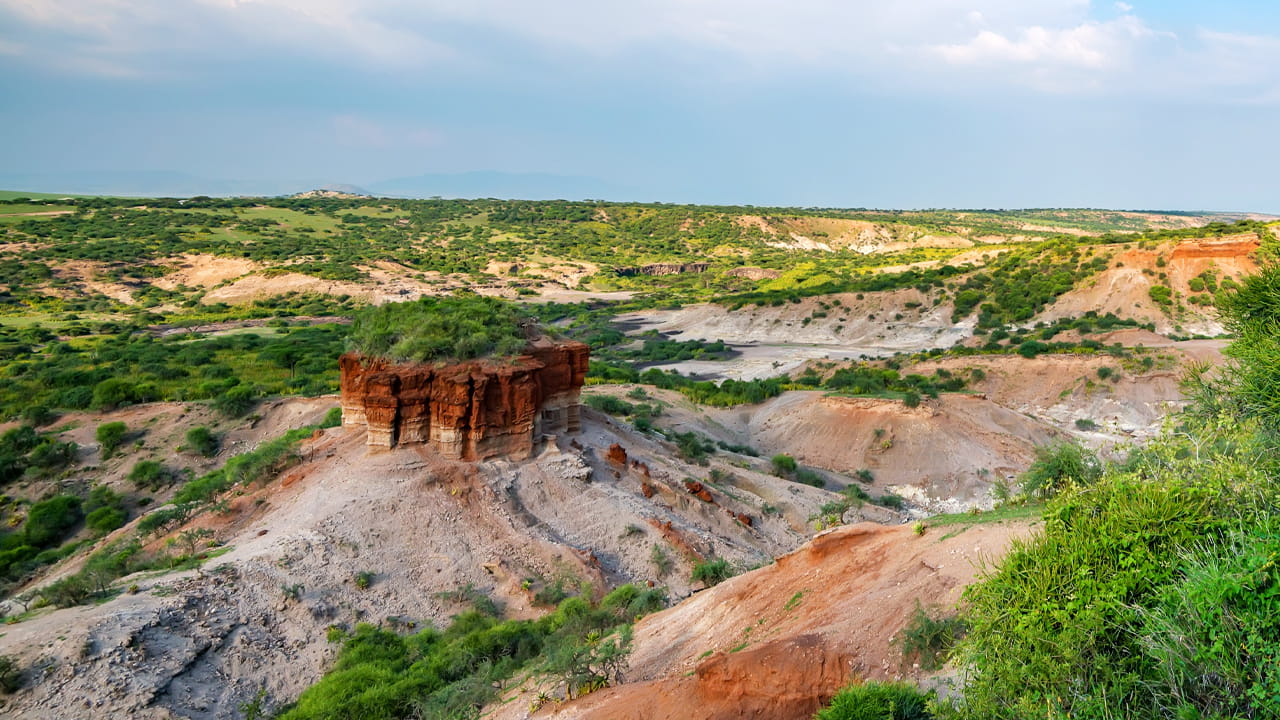
There is a place in Tanzania where time is measured in millions of years. Not in hours of flight, not in days on safari, but in geological eras that have shaped the very history of our species. The Olduvai Gorge cuts into the earth like an ancient wound, ninety metres deep and almost fifty kilometres long, nestled between the plains of the Serengeti and the highlands of the Ngorongoro. It is here, in this canyon carved by time and the forces of the earth, that Mary and Louis Leakey unearthed the first evidence of our most distant ancestors, irreversibly reshaping our understanding of human origins.
Visiting the Olduvai Gorge Museum is not simply a cultural stop-off during a safari. It is an experience that changes the way you view the surrounding landscape. That endless savannah you admire from your 4×4, those golden plains where millions of wildebeest and zebras migrate today, are the very same lands that the first humans walked upon millions of years ago. Walking here means treading the very ground that witnessed the first steps of our evolution, and this realisation transforms a visit into something deeply personal.
What is the Olduvai Gorge?
Visiting the Olduvai Gorge Museum means coming into direct contact with the deepest roots of our species. This is not a museum in the traditional sense of the word, with dusty display cases and faded captions. It is a living place, situated exactly where the discoveries were made, where the earth has revealed the secrets it had kept for millions of years. The gorge itself is the greatest artefact of all: a canyon that cuts through the Serengeti plains like an open-air geological archive, exposing layers of sediment that tell the story of human evolution with a comprehensiveness that no other site in the world can match.
The discoveries made by Mary and Louis Leakey, who devoted over thirty years of tireless research to this site, have transformed Olduvai from a remote African gorge into a global centre of excellence for palaeoanthropology. The Zinjanthropus skull, the remains of Homo habilis, the stone tools of the Olduvai culture: each discovery has added a vital piece to our understanding of who we are and where we come from. The museum collects, preserves and showcases these discoveries in a setting that enhances their significance, because observing a fossil dating back almost two million years whilst standing in the very gorge from which it was unearthed is an experience that no urban exhibition could ever replicate.
This experience is aimed at all types of traveller. You don’t need to be an archaeologist or a prehistory enthusiast to be captivated: the emotional power of the place speaks to anyone with a curiosity about their own history. From families with children to cultural travellers, from students to photographers seeking unique scenery, Olduvai offers something rare amongst safari activities: the chance to pause, look back in time, and realise that this land is not just home to Africa’s great wildlife, but the place where it all began.
A journey to the origins of humanity in the heart of Tanzania
Olduvai Gorge is recognised as one of the most important palaeoanthropological sites on the planet. A UNESCO World Heritage Site since 1979, this gorge’s sedimentary layers contain an unbroken record of over two million years of human evolution – the longest and most complete ever documented. The artefacts unearthed within these rocky walls have revolutionised science, providing decisive evidence of how our ancestors lived, moved and crafted their earliest tools.
For travellers exploring the Northern Tanzania circuit as part of a Tanzanian safari, Olduvai offers a truly unique experience: the meeting point between wildlife adventure and cultural discovery. Whilst game drives in the parks provide close encounters with wildlife, a visit to the gorge and the museum opens a window onto a past that belongs to all of humanity. It is that rare moment on a journey when one pauses to reflect not only on the beauty of nature, but also on our place within it.
No prior scientific knowledge is needed to appreciate what Olduvai has to offer. Local guides transform complex facts into compelling stories that captivate everyone from paleoanthropology enthusiasts to curious travellers, and from adults to children. It is an experience that profoundly enriches the very meaning of a trip to Africa.
Where is the Olduvai Gorge?
The Olduvai Gorge – whose name derives from the Maasai word ‘oldupai’, referring to the wild sisal that grows abundantly in the area – is situated within the Ngorongoro Conservation Area in northern Tanzania. Its location is strategic: the museum lies along the road linking the Ngorongoro Crater to the Serengeti, about six kilometres from the main junction where the monument dedicated to Zinjanthropus stands, one of the site’s most famous discoveries.
This location makes a visit here a natural and ideal stop-off whilst travelling between the two parks, without any detours or wasted time. Those travelling from the crater towards the Serengeti – or vice versa – can easily fit the approximately two-hour visit into their itinerary. The route to the museum itself passes through the gorge, offering spectacular views from the very start: the layered walls of the canyon, the colours of the earth ranging from ochre red to straw yellow, and the silent vastness of the surrounding plains.
What can you see at the Olduvai Gorge Museum?
The Olduvai Gorge Museum houses an extraordinary collection that documents millions of years of human and natural history. From hominid fossils to the stone tools of early prehistoric cultures, from the remains of extinct animals to multimedia displays that provide context for each artefact, a visit offers a comprehensive journey through the key stages of our evolution. Each gallery tells a different chapter of this ancient history, with exhibits presented in such a clear and accessible way that the content is engaging for visitors of all ages and backgrounds.
Fossil finds and evidence of hominids
At the heart of the museum lie the artefacts that have made Olduvai famous throughout the world. The fossils on display document the presence of at least four different species of hominids that inhabited these lands in successive eras: from Paranthropus boisei, whose skull was discovered by Mary Leakey in 1959 on a day that was to change the history of science, to Homo habilis, considered the first to create stone tools, and on to Homo erectus, the ancestor with the largest brain who preceded the first Homo sapiens.
Alongside the hominid remains, the museum displays fossils of prehistoric plants and mammals, skeletons of extinct animals that shared the ecosystem with our ancestors, and a collection of stone tools that bear witness to the growing cognitive complexity of early human cultures. Many of the exhibits are originals; others are highly accurate casts made to protect the most fragile pieces. The combination of authentic artefacts and reproductions allows visitors to appreciate details that would otherwise remain inaccessible.
The Laetoli footprints
An entire room in the museum is dedicated to what is perhaps the most moving exhibit of the entire visit: the Laetoli fossil footprints. Discovered in 1978 by Mary Leakey’s team some 45 kilometres from Olduvai, these footprints date back 3.66 million years and represent the oldest undisputed evidence of upright walking in the history of human evolution.
Three individuals of the species Australopithecus afarensis – the same species as the famous Lucy – walked across a layer of damp volcanic ash deposited by the eruption of the nearby Sadiman volcano. Subsequent eruptions covered and preserved those footprints in a miraculous way. On display at the museum is a cast of the entire trackway, approximately 27 metres long, and the emotional impact of standing before those marks is difficult to describe: they are the footsteps of beings who walked upright with a gait surprisingly similar to our own, millions of years before the invention of stone tools.
The renovated museum
In 2017, the Ngorongoro Conservation Area Authority opened a brand-new facility to replace the old museum founded by Mary Leakey in the 1970s. The new building, constructed from local quartzite stone, houses expanded and modernised exhibitions featuring detailed information panels and multimedia displays that enhance the visitor experience. The facility also includes a covered viewing platform, designed as a natural theatre overlooking the gorge, where curators hold presentations and talks for visitors. Rounding off the offering are a Maasai cultural area, a small restaurant and a specialist bookshop.
How to visit
The visit to the Olduvai Gorge museum lasts around two hours and is divided into stages that combine exploration of the landscape with scientific and cultural insights. Unlike safari activities, which require early morning wake-up calls or specialised equipment, the visit to Olduvai takes place during normal daytime hours and does not require any complex preparations, fitting naturally into the rhythm of the journey between one park and another.
Crossing the gorge
The first encounter with Olduvai is visual and striking. To reach the museum, you cross the gorge itself, travelling along a road that offers spectacular views of the canyon’s stratigraphy. The gorge’s walls, up to ninety metres deep, reveal geological strata that recount millions of years of history like the pages of an open book. The colours of the rock change with the layers, from the dark basalt of the deepest levels to the lighter volcanic ash of the upper strata. It is a perfect, dramatic introduction to what the museum holds, a visual foretaste of the depth of time you are about to explore.
Guided tour of the museum and archaeological sites
On arrival at the museum, a specialist local guide accompanies visitors through the exhibition galleries and the surrounding archaeological sites. A guide is compulsory for access to the excavation areas; this is a necessary measure to protect the artefacts and to ensure a high-quality, informative experience. The explanations, given in English, are tailored to the audience present and are engaging even for the youngest visitors.
The tour begins with an introductory presentation in the panoramic conference area, where the curators provide an overview of the site’s history and the key discoveries. It then continues through the museum galleries, where the artefacts are contextualised through display panels, maps and reconstructions, before moving on to the outdoor archaeological sites, where visitors can view the excavation areas that have yielded the most significant fossils. The combination of storytelling, artefacts and the landscape creates an immersive experience that conveys the significance of the discoveries in an immediate and memorable way.
Practical information and requirements
Planning a visit to the Olduvai Gorge Museum is straightforward, but knowing a few practical details will help ensure a smooth experience. From suitable clothing to what’s included in the price, here’s everything you need to know before exploring one of the most extraordinary sites in Tanzania’s national parks.
Who can take part
A visit to Olduvai Gorge is an experience suitable for everyone. There are no age restrictions: families with children, history and archaeology enthusiasts, students, cultural travellers and anyone wishing to enrich their safari with a different dimension will find this visit offers significant added value. The guides are accustomed to tailoring their explanations to suit the audience, making the content accessible and engaging even for the youngest visitors.
It is important to note that the museum has limited accessibility for people with reduced mobility. The surrounding terrain and some parts of the archaeological trail may prove challenging for those with mobility difficulties. We recommend taking this into account when planning your trip.
What to bring
The equipment required is minimal. A camera is essential: photography is permitted both inside the museum and in the outdoor areas, and there is no shortage of photo opportunities, from the exhibits on display to the views of the gorge. It is advisable to bring plenty of water and adequate sun protection, as the area is exposed and temperatures during the middle of the day can be high. A wide-brimmed hat and sunglasses round off the ideal kit for a comfortable visit.
What’s included
The tour package includes admission to the museum, a local English-speaking guide and access to the archaeological sites. The guide accompanies visitors throughout the entire experience, providing detailed explanations of each artefact and every part of the tour.
It is important to note that the cost of a visit to Olduvai Gorge is generally treated as an extra on top of the main safari package. This is standard practice in most itineraries in northern Tanzania, and the supplement reflects the unique value of an experience that has no equivalent anywhere else in the world. Reputable operators always provide a clear quote that sets out what is included in the basic package and what the additional costs are.
When to visit Olduvai Gorge
The Olduvai Gorge Museum is open all year round, with no seasonal restrictions or closing days. Unlike other safari activities, which depend on weather conditions or wildlife patterns, a visit to the museum and the gorge can be planned at any time of year, ensuring complete flexibility when organising your trip.
The ideal time to fit this visit into your itinerary is during the transfer between the Ngorongoro Crater and the Serengeti National Park – a route included in the vast majority of safaris on the Northern Tanzania circuit. The stop, lasting around two hours, provides a welcome break from the journey and adds a profound cultural dimension to a trip that is otherwise focused on wildlife.
For shorter safaris, where every hour is precious, a visit requires careful consideration of priorities with your tour operator. In longer, more comprehensive itineraries, however, Olduvai fits naturally as an unmissable stop – a moment of reflective pause that enriches the overall experience and offers a cultural counterpoint to the thrills of the game drives.
Why visit Olduvai Gorge with Tracks of Africa
Incorporating a visit to Olduvai Gorge into your safari requires a tour operator with in-depth knowledge of the area who can seamlessly organise timings, transfers and stops. Tracks of Africa, a safari tour operator in Tanzania with years of experience in the Northern Circuit, incorporates a visit to the museum into its bespoke itineraries with the same care and attention it devotes to game drives and nature experiences. A stop at Olduvai is never a hastily added extra: it is a carefully planned element, timed to fit perfectly into the journey at just the right moment, when the pace of the itinerary makes it ideal.
Tracks of Africa’s guides are familiar with the site’s history and know how to prepare travellers for the experience even before they reach the museum, placing the visit within the wider context of the part of Tanzania they are exploring. This preparation transforms a stopover into a moment of genuine discovery, where every artefact takes on a richer meaning because it is woven into the overall narrative of the journey.
Visiting Olduvai Gorge means experiencing first-hand the starting point of our history as a species. It is an experience that changes the way you look at the surrounding savannah, because once you have seen the Laetoli footprints and the fossils of the earliest hominids, those endless landscapes are no longer merely the backdrop to a safari: they become the stage on which humanity’s greatest adventure unfolded.
Ready to discover the origins of humanity? Contact us to include a visit to Olduvai Gorge in your tailor-made safari in Tanzania.