
Tented camp or lodge in Tanzania? It’s one of the most frequently asked questions when you start planning a safari. At first glance, the difference seems simple: on the one hand, a tent; on the other, a room. In reality, when it comes to a safari, the choice of accommodation involves much more than just the type of accommodation.
They change the atmosphere, your relationship with the surroundings, the level of privacy, the facilities and, above all, the way you experience the destination.
Two different ways to experience a safari
The most obvious difference lies in the structure.
A lodge in Tanzania is generally a permanent establishment, comprising rooms or bungalows and communal areas. It can vary greatly in character, ranging from the simplest accommodation to high-end establishments, but generally retains a similar layout to that of a hotel set in natural surroundings.
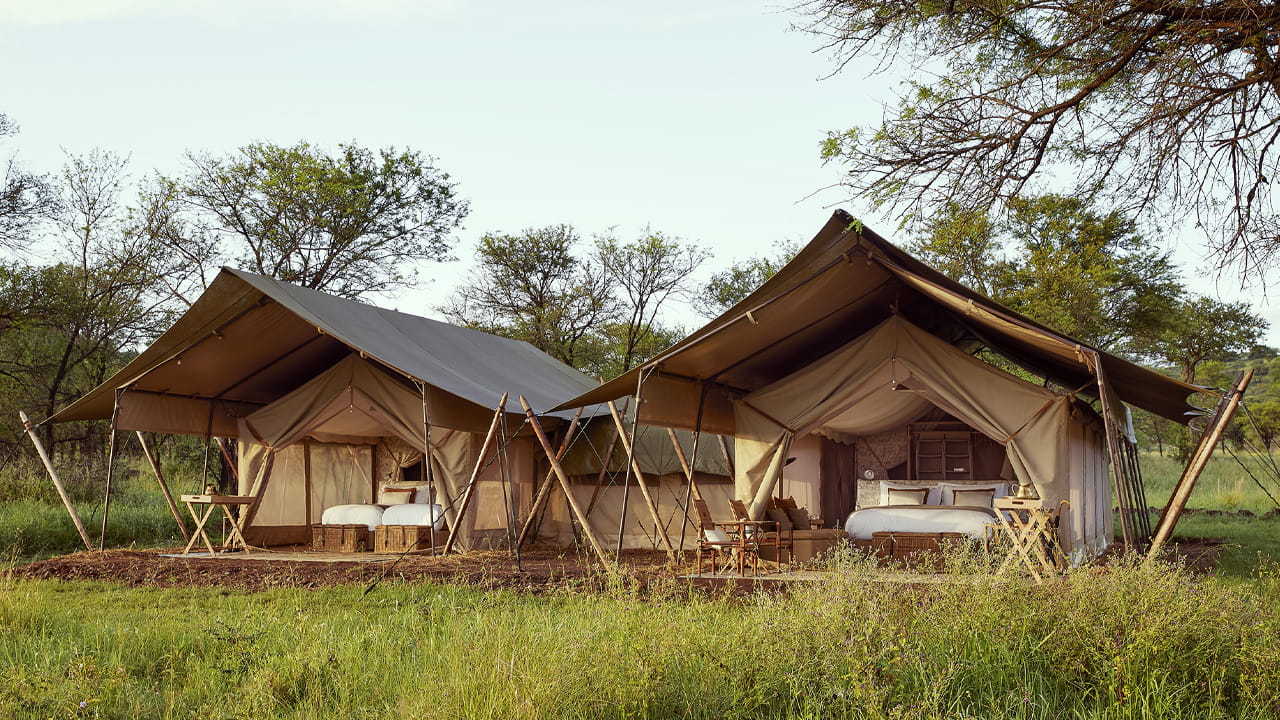
A tented camp in Tanzania, on the other hand, uses tents designed for hospitality, often equipped with en-suite bathrooms and all the main amenities. The term ‘tented’ does not, therefore, necessarily imply basic accommodation.
The real difference, however, is most evident in the relationship with the environment.
Staying in a tented camp can give you a more immediate sense of being immersed in the landscape: in the evening, when the sun sets and the camp grows quieter, you can hear the sounds of nature more clearly.
A lodge, on the other hand, can offer an experience more akin to that of a hotel, whilst being situated in the heart of a natural area.
Comfort: is the lodge really more comfortable?
Not necessarily.
A lodge may offer spacious rooms, a restaurant, a swimming pool, a lounge and other facilities. However, even a high-quality tented camp can guarantee a high standard of comfort.
The question to ask yourself is therefore not simply ‘which is more comfortable?’, but: ‘What sort of comfort am I looking for on a safari?’
Those who prefer accommodation more akin to a hotel might find a lodge more to their liking. Those who, on the other hand, regard being in touch with nature as part of the experience might appreciate a tented camp more.
What changes when the sun goes down?
This is probably the moment when the difference between the two solutions is most noticeable.
In a lodge, the solid walls and permanent structure provide greater separation from the outside world.
In a tented camp, on the other hand, nature is much more present.
This does not mean that animals are allowed into the tents or that safety is compromised: the camps follow specific procedures and, where necessary, staff accompany guests on their night-time movements.
But that means that the night is part of the experience.
The sounds of the savannah – the wind and the calls of the animals – can become just as much a part of the journey as a game drive.
Location is more important than the type of facility
This is perhaps the most important factor to bear in mind.
A lodge is not necessarily further away from the animals than a tented camp, and a tented camp is not automatically in the best location for a safari.
What makes the difference is where the facility is actually located.
So, when comparing two accommodation options, it is worth checking:
• the distance from the park’s most interesting areas
• its location in relation to the route
• the time it takes to reach the safari areas
• the ability to carry out certain activities
• whether it is located inside or outside the protected area, where applicable
A slightly simpler place to stay, but in the right location, may be more in keeping with the itinerary than a more prestigious but less practical accommodation.
And the budget?
Nor does the price automatically distinguish a lodge from a tented camp.
In fact, both categories include establishments that vary greatly in terms of standard, location and facilities.
The cost may depend on:
• accommodation category
• travel period
• location
• services included
• number of nights
• Meal plan
That is why it is more useful to compare the overall experience and what is included, rather than focusing solely on the price per night.
Tented camp or lodge in Tanzania: which to choose?
There is no one-size-fits-all solution.
The tented camp might be suitable if you’re looking for:
• a greater sense of being at one with nature
• a more intimate atmosphere
• a greater sense of connection with the savannah
• accommodation that forms part of the safari experience
The lodge may be suitable if you prefer:
• a hotel-style accommodation
• a greater sense of protection and separation from the outside world
• a wider range of services
• accommodation that is particularly well-suited to the family’s needs
However, these are general guidelines. Your choice should always take into account the itinerary, the season and the specific features of each accommodation.
Is it always best to choose the same type of accommodation?
Not necessarily.
A safari can alternate between lodges and tented camps depending on the different stages of the trip.
In fact, this solution can offer a variety of experiences: greater comfort in one area and a deeper connection with nature in another.
This is one of the reasons why accommodation should not be considered separately from the itinerary.
Tented camp or lodge: the choice depends on the trip
When organising a safari in Tanzania, the question shouldn’t just be ‘where shall we stay?’, but also ‘what kind of experience do we want to have in that area?’
The time of year you’re travelling, the parks you’ve chosen, your travel schedule and the type of safari you’re looking for will help you find the most suitable accommodation.
Tracks of Africa offers a range of accommodation options in Tanzania’s main safari areas, from lodges to tented camps, selecting them according to the itinerary and type of trip.
You can find out more about accommodation options in our guide to where to stay in Tanzania and Zanzibar.
To find out how the various accommodation options are combined within the tours, please take a look at our Tanzania safari packages.
In summary
Tented camp or lodge in Tanzania?
The answer depends less on whether it’s called a ‘tent’ or a ‘lodge’ and much more on the location, atmosphere, comfort and the sort of experience you’re looking for.
Because in Tanzania, even the place where you stay can become part of the safari.